
Three-Phase Supplies & Distribution Boards
Power for machinery, bigger buildings and growing businesses, distributed safely and in balance.
Most homes run on a single-phase supply. Many business premises do too, until the day a new machine arrives, an extra floor goes in or the old board simply runs out of ways. At that point the question becomes how power reaches the building and how it is shared out inside. Adtec Electrical installs three-phase circuits, distribution boards and sub-mains for workshops, warehouses, offices and industrial units.
When a business needs three-phase
A three-phase supply delivers power over three conductors rather than one, which suits large motors and heavy loads. Typical triggers are compressors, CNC machines, vehicle lifts, larger welders, commercial kitchens and big heating or cooling plant. A building with a lot of general load can also benefit, because spreading circuits across three phases lowers the current on each one. If you are unsure, list the equipment you plan to run and we will look at the ratings with you.
Applying for a new or upgraded supply
The cables up to and including the meter belong to the local distribution network operator (DNO). A new three-phase connection, or an increase in capacity, is applied for through them, and they carry out work on their side. Lead times and costs for that part are set by the network operator. We help you estimate the load to ask for, then install the main switch, distribution and circuits on your side once the supply is ready.
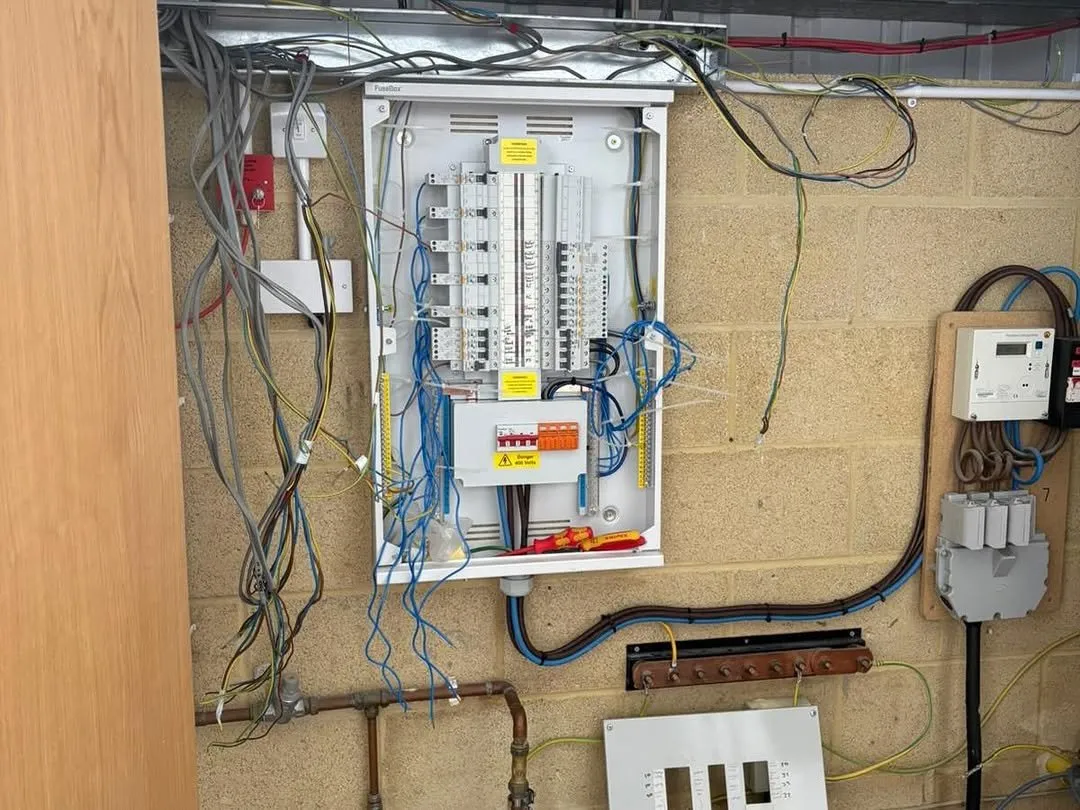
Distribution boards and commercial consumer units
A distribution board is where circuits get their protection. In smaller premises it may be a commercial consumer unit, in larger ones a three-phase board with space for future ways. We choose a board sized for today's circuits plus room to grow, with protective devices matched to each circuit and clear labelling so whoever resets a breaker knows what it feeds.
Sub-mains and machinery supplies
A sub-main carries power from the main board to a local board somewhere else: a mezzanine office, a production area, a yard building. Each machine then gets its own appropriately rated supply and local isolation, so it can be switched off safely for maintenance. Cable routes are planned with your forklift paths, racking and roller doors in mind.
Balancing loads
On a three-phase system the loads should be shared reasonably evenly. A board with everything piled on one phase can trip or overheat even though the total looks fine. When we add circuits we check how the existing load is spread and arrange the new circuits accordingly.
Testing and certification
New work is tested and certified on completion. If the rest of the installation hasn't been inspected for a while, a commercial EICR gives you its condition before more load is added. For the wider picture of work on industrial buildings, see warehouse and industrial electrics.
Upgrading an old or overloaded board
Many units we visit still have the board that was fitted when the building went up, with circuits added over the years until there are no spare ways and the labels no longer mean anything. Replacing it is a chance to tidy up: separate lighting from power, give machinery its own protection, and record the circuits properly. We prepare as much as possible in advance so that the changeover, which does need a planned shutdown, is kept short and agreed with you beforehand.
Larger premises sometimes have several boards fed from a main switch panel. In that case we look at the whole arrangement: the size of each sub-main, how much spare capacity the main panel has, and whether discrimination between devices means a fault trips only the local board rather than the whole building. Getting this right keeps a fault in one corner of a warehouse from stopping production everywhere else.
We are based at Lyford Business Centre near Wantage and work Monday to Friday, 7:30am to 5:30pm. Check the areas we cover, or call 01235 430442 to arrange a survey.