
Commercial EICR Cost: What Affects the Price
Why one commercial electrical inspection can take far longer than another, and what to send us for an accurate quote.
If you manage an office, shop, warehouse or industrial unit, sooner or later someone will ask for an Electrical Installation Condition Report. The first question is usually "how much?", and the honest answer is that it depends on the building. This guide explains the factors that drive the cost, so you can compare quotes on a fair basis and know what to send for an accurate price. For what the inspection itself involves, see our commercial EICR page.
1. Why commercial EICRs are quoted per site
A domestic EICR covers a fairly predictable installation. Commercial buildings vary enormously. A small office suite might have one board and a dozen circuits. A distribution warehouse might have a main panel, several sub-boards, three-phase supplies to machinery, and lighting at height across thousands of square metres. A price list cannot cover both honestly, so we quote each site on its own details.
2. Number of distribution boards and circuits
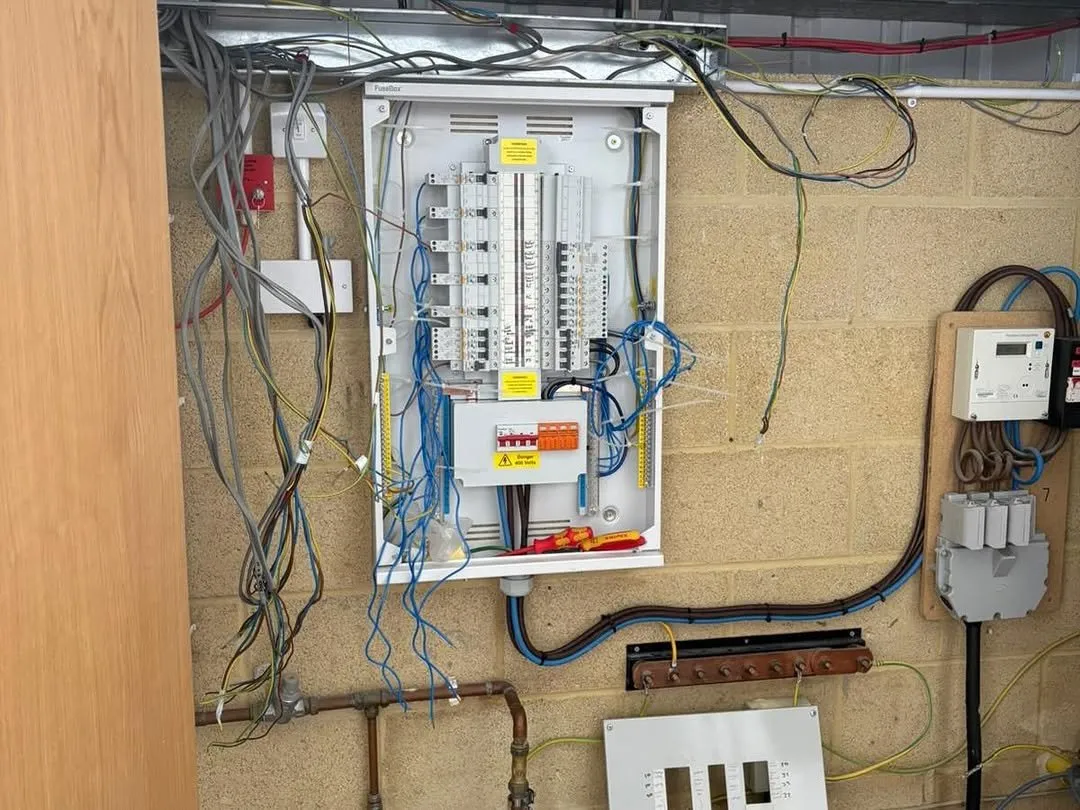
Testing is carried out circuit by circuit and board by board, so this is the single biggest factor in how long an inspection takes. Each board has to be opened, inspected and tested, and each circuit's results recorded. Three-phase boards and sub-mains add more to check. If you know roughly how many boards there are and how many ways each one has, that alone gives us a good starting point.
3. Type of premises
- Offices tend to have lots of small power circuits and lighting spread across floors and rooms, often above suspended ceilings.
- Shops and showrooms often combine display lighting, tills and back-of-house areas, and need testing planned around customers.
- Warehouses bring high-level lighting and long cable runs, so access equipment may be needed to inspect fittings.
- Industrial units add machinery supplies, three-phase circuits and equipment that cannot simply be switched off at any moment.
4. Access, isolation and keeping the business running
Parts of an EICR need circuits to be isolated, which means switching them off. In a busy building that takes planning. We agree in advance which circuits can go off and when, and work around essential equipment such as servers, refrigeration or production machinery. Within our working day, Monday to Friday 7:30am to 5:30pm, we sequence the work to keep disruption low.
Access affects time too: locked rooms, boards behind stock, ceiling voids and high-level fittings all need arranging. The more of this that is ready on the day, the smoother the inspection runs.
5. Remedial work is quoted separately
The inspection and report are one cost. Fixing what the report finds is another, and it cannot be known in advance. It might be nothing more than a missing circuit chart, or it might be damaged accessories, missing RCD protection or an overloaded board. We quote remedial work after the report, item by item, so you can see exactly what each fix involves. If something dangerous is found during the inspection, we make it safe and tell you straight away.
6. How Adtec quotes: what to send us
- The address and type of premises, and roughly how big it is.
- How many distribution boards there are, if you know, and whether supplies are single or three-phase.
- A copy of the previous EICR, if you have one.
- Any times or areas that are difficult, such as equipment that must stay on.
- Whether the report is needed for an insurer, landlord or lease, and by when.
With that, we can usually give a fixed written quote, or arrange a short visit first if the building needs a look. If you also have alterations planned, for example in an office, our page on office electrical installations covers that side.
7. Next steps
Read more about our commercial EICR service, or how it fits alongside other certificates on our testing and certification page. Adtec Electrical has tested and installed in commercial buildings since 2014. For a fixed quote, call 01235 430442 or send us the details.
Frequently asked questions
Want a price for your job?
Call 01235 430442 (Monday to Friday, 7:30am to 5:30pm) or send us the details.